Solar PV
Generate your own electricity, on your own roof
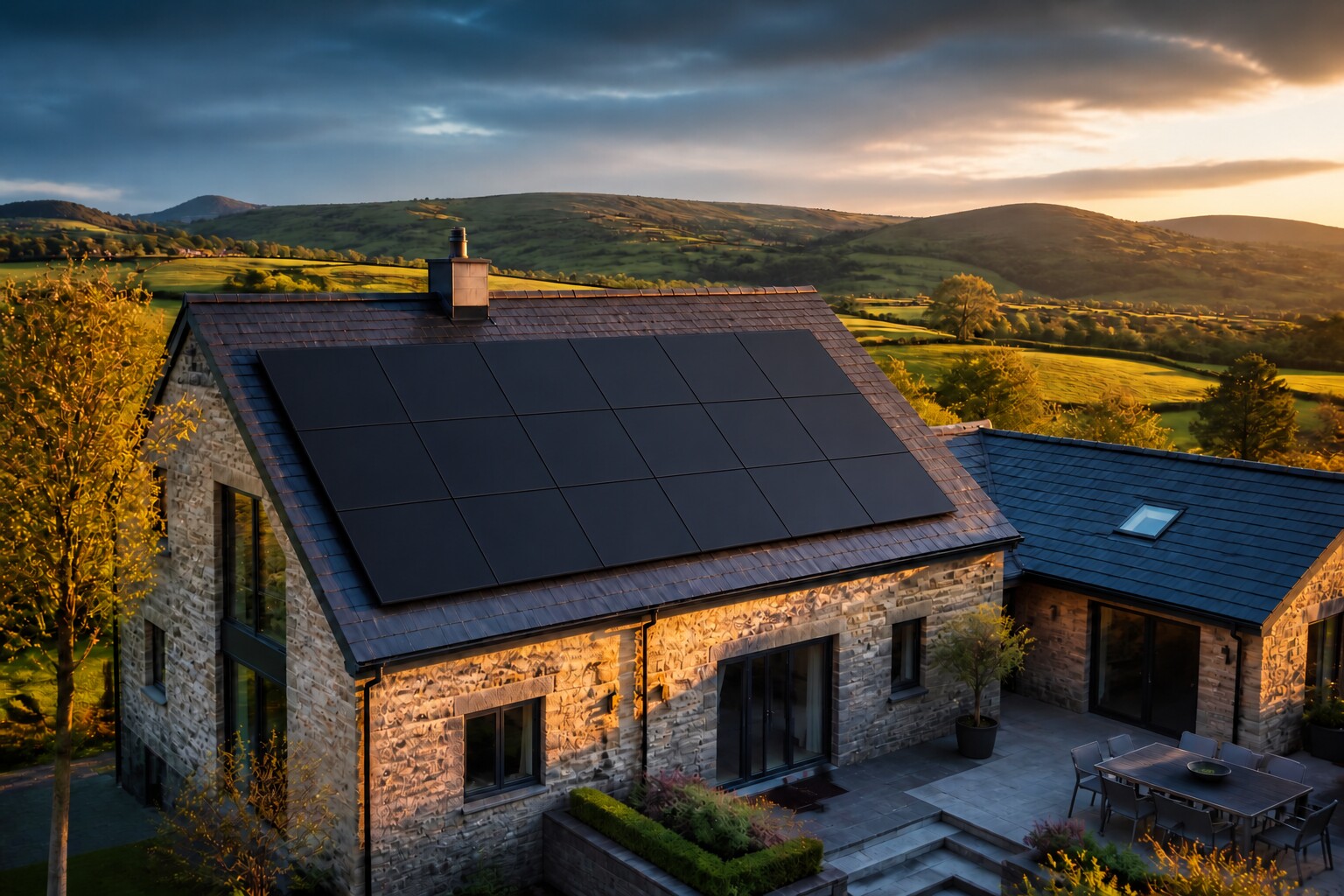
A well-designed solar array is the cheapest electricity most UK properties will ever buy. Here is exactly how it works, what it's made of, and what to expect it to do.
Why solar
What solar actually changes about your bills
Solar doesn't make electricity free. It replaces the units you'd otherwise buy at retail price with units you generate at a fixed, already-paid-for cost.
You buy less
Every kWh you generate and use immediately is a kWh you don't import at retail price. This is where most of the value sits, rather than in export.
You're less exposed
A large share of your consumption becomes insulated from wholesale price movements for the 25-year life of the array.
You can get paid for surplus
Generation you don't use or store can be exported under a Smart Export Guarantee tariff. Rates differ between suppliers, so it's worth shopping around.
The physics, briefly
How solar PV works
Photovoltaic cells absorb light and release electrons, producing direct current. An inverter converts that DC into the alternating current your property runs on. What you don't use is stored or exported.
- 01
Daylight hits the array
Cells generate DC whenever there is usable light. Direct sun produces most, but diffuse daylight still produces.
- 02
The inverter converts
DC becomes 230V AC, synchronised with your supply.
- 03
Your property uses it first
Generation always serves on-site load before anything else.
- 04
Surplus is stored or exported
A battery takes the excess; otherwise it flows to the grid.
System components
What's actually in a solar installation
Four things determine whether a system performs for 25 years or becomes a maintenance problem. None of them is the panel brand on the brochure.
Panels
Monocrystalline modules, typically around 400–450W each. All-black options suit most UK roofs visually. What matters more than the badge is degradation rate, warranty length and the manufacturer's ability to honour it.
Inverter
Converts DC from the roof into AC for your property. A hybrid inverter can also manage a battery, which usually makes storage cheaper to add later. Shaded roofs may justify optimisers or microinverters.
Monitoring
App-level visibility of generation, consumption, export and battery state. It is how you spot a fault early and how you learn when to run heavy appliances.
Isolation & metering
AC and DC isolators, protective devices and a generation meter, installed to current UK wiring regulations and signed off at commissioning.
Expected generation
What a UK system realistically produces
Output depends on roof orientation, pitch, shading and location. A south-facing, unshaded roof is the benchmark; east–west splits generate a little less overall but often match household demand better.
Pricing guidance
What it costs
These examples use our published Solis packages. We review your property details and confirm the final design and price in a written quote.
Figures published by our team. Qualifying domestic installations currently attract 0% VAT until 31 March 2027. We estimate this saves an average household around £1,850. Prices are indicative, not a quotation.
Interactive
Size an indicative system for your property
Solar Explorer
Get an indicative system size in 30 seconds
Choose a system and tell us a little about your electricity use. No contact details needed to see your estimate.
Used to check we cover your area. Location-specific irradiance data is not yet connected — see the assumptions note below.
Suggested Sigenergy package
- System size
- 6.72 kWp
- 480 W AIKO panels
- 14
- Annual generation
- 6,048 kWh
- Battery
- 9.04 kWh
- Indicative annual benefit
- £1,246
- Indicative payback
- 8.9 yrs
Starting from, installed
£11,050
Sigenergy 14-panel package · 9.04 kWh battery.
Solar £8,800 + battery £2,250.
Optional gateway is not included in this price.
Indicative only. These figures use simplified planning assumptions (900 kWh/kWp per year, 480W panels, 26p/kWh import, 8p/kWh export) and are not a quotation, a performance guarantee or financial advice. Guide price for the package shown. Roof layout, the number of roof faces and panel arrays, and the scaffolding required can affect the final price. We review these during the full design and confirm the price in your written quote. Further checks may be needed for some properties.
Installation
What happens on site
- Scaffold erected and access agreed before any roof work begins
- Roof hooks and rails fixed into rafters, weather-tight by design
- Panels mounted, DC strings terminated and tested
- Inverter, isolators and protective devices installed and labelled
- System energised, tested and commissioned to UK wiring regulations
- Monitoring configured and demonstrated before we leave
- Documentation, certificates and handover pack issued
Warranty
What's covered, and for how long
Three separate warranties
Product warranty (the hardware itself), performance warranty (guaranteed output retention over time) and workmanship warranty (the installation). They are not the same thing and they rarely run for the same length of time. Always compare all three when you compare quotes.
FAQs
Solar PV questions
Find out what your roof can do
We review your roof details and electricity use, then prepare a design and itemised quote with a generation estimate. There is no obligation to proceed.
Typical enquiry takes under two minutes · We never sell your details on